
The Hidden Science of Spinal Stability: Why Your Back Has a “Memory”
If you’ve ever spent a long day hunched over a laptop or hours behind the wheel of a car, only to feel “stuck” or unstable when you finally stand up, you aren’t just imagining things. For years, we’ve told patients that “posture matters,” but recent breakthroughs in neuroscience are finally explaining why.
It turns out your spine has a “neural memory,” and your muscles can actually become “tricked” by your previous positions. At The Lakes Chiropractic, we stay at the forefront of this research to help you understand not just where it hurts, but how your nervous system is controlling—or miscontrolling—your movement.
1. The Mystery of “Spinal Memory”: Understanding Thixotropy
The secret lies in a property of your muscles called thixotropy 1, 2. Think of your muscles not just as cables that pull on bones, but as sophisticated sensors. Inside these muscles are tiny “muscle spindles” that send constant data to your brain about your spine’s position 1, 3.
However, skeletal muscle is thixotropic, meaning its physical properties change based on its length history 1, 2. When you hold a muscle at a constant length—like sitting in a slouched position—stable, “stuck” crossbridges form between the muscle fibers 2, 4. These aren’t the normal recycling bonds that happen during exercise; these are “non-recycling” bonds that act like microscopic glue, setting the muscle’s “stiffness” to that specific slouched position 2, 5.
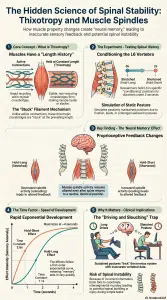
1: Spinal Stability and Thixotropy Science
As the infographic above illustrates, when you move out of that held position, those “stuck” bonds don’t immediately let go. This creates what researchers call “Neural Memory” 6, 7.
2. How Your Brain Gets “Fake News” from Your Spine
The danger of this muscle memory is that it generates inaccurate sensory feedback 4, 8. Research by Pickar and Ge demonstrated that holding a spinal segment in a specific position for as little as two to four seconds is enough to significantly alter the signals sent to the brain 7, 9.
- The “Hold-Long” Effect: If a muscle is held in a stretched position (like the back muscles during a deep slouch), the muscle spindles become “unloaded” or slack 5, 6. When you return to a neutral standing position, these sensors send decreased activity to the brain, essentially telling the brain the muscle is shorter than it actually is 5, 7.
- The “Hold-Short” Effect: Conversely, holding a muscle in a shortened position “loads” the spindle 6. Upon returning to neutral, the brain receives increased activity, creating the false sensation that the spine is more stretched than it really is 5, 7.
The most startling find? These errors develop incredibly fast. The “Hold-Long” effect has a time constant of just 1.1 seconds, while the “Hold-Short” effect takes about 2.6 seconds 7, 8. Within just four seconds of history, the “fake news” being sent to your brain reaches its maximum 7, 8.
3. Is Your Brain “Smudged”? Debunking the Cortical Myth
For the last two decades, a popular theory in chronic pain was “cortical smudging”—the idea that the brain’s map of the back becomes blurry or disorganized in people with chronic low back pain (CLBP) 10, 11.
However, a landmark study utilizing advanced fMRI technology has challenged this 12, 13. Researchers found that even in patients with long-term chronic pain and distorted body image, the somatotopic maps (the brain’s “GPS” for the back) remain stable and well-organized 12, 14. The map isn’t “smudged”; rather, the way the brain interprets and integrates the incoming data is what changes 11, 12, 15.
4. The Brain’s Protective “Overdrive”
If the map in the brain is still clear, why do people with chronic pain move so differently? The answer lies in sensorimotor integration 16, 17.
New research from 2024 shows that individuals with chronic low back pain process sensory signals from the lumbopelvic area differently than healthy people 16, 18. Because the brain is receiving inaccurate or “threatening” information from the thixotropic muscles we discussed earlier, it enters a state of protective compensation 19, 20.
In people with chronic pain, the brain actually increases the “corticospinal drive”—essentially sending extra-strong electrical signals to the back muscles to force them to stabilize 16, 21, 22. While this “over-protection” is meant to help, it can lead to increased spinal loading, muscle fatigue, and a cycle of persistent pain 20.
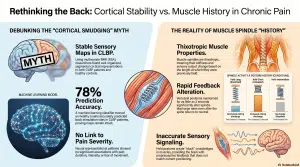
Spinal Memory and Proprioception Mechanics
This second infographic highlights how this internal “miscommunication” leads to a mismatch between what your spine is doing and what your brain thinks it is doing, potentially leading to injuries during simple, non-demanding tasks 23, 24.
5. What This Means for Your Recovery
At The Lakes Chiropractic, we don’t just “crack backs”; we help reset this complex communication network. Understanding that your spine has a “memory” changes how we approach treatment:
- Breaking the “Stuck” Bonds: Movement is the only way to break the thixotropic crossbridges that form during prolonged sitting 2, 25. Regular adjustments and specific movements “reset” the muscle spindles, clearing the “neural memory” that leads to instability 24, 26.
- Sensory Integration Training: Since we know the brain’s “map” is stable, our goal is to improve how your brain uses that map 11, 15. This is why we prescribe specific motor control exercises—they teach your brain to trust the signals from your spine again 27, 28.
- The “Walking After Driving” Rule: Research suggests that simply walking after a long drive can help “reset” the neural feedback system, significantly reducing your risk of a sudden back injury 24, 29.
Conclusion
Your back pain isn’t just about “tight muscles”—it’s a high-speed data problem between your spine and your brain. By understanding the science of thixotropy and sensorimotor integration, we can move beyond temporary relief and toward true spinal stability.
Ready to reset your spinal memory? Schedule your assessment at The Lakes Chiropractic today.